

The “IX. Symposium on Problems and Solutions in Occupational Health and Safety in Turkey,” themed “Innovative Trainings and Practices that Develop a Safety Culture in Workplaces,” is being held at Üsküdar University.
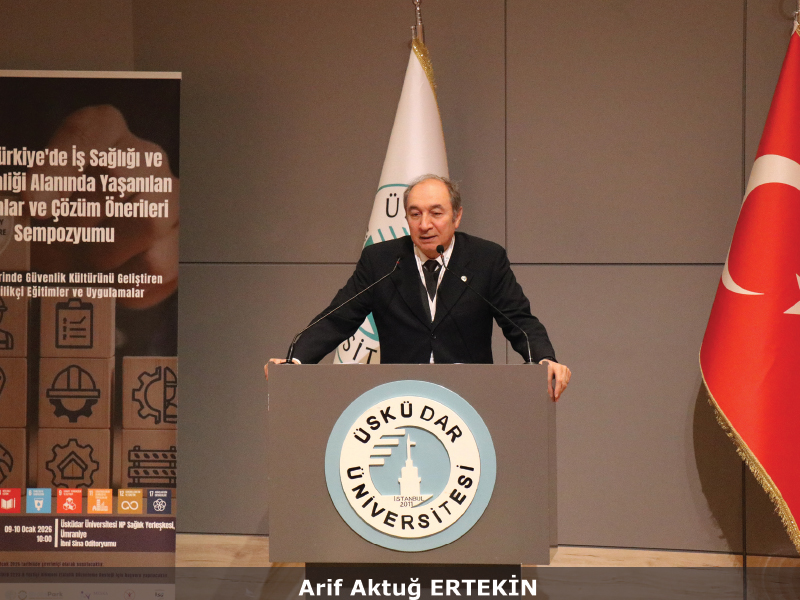
Prof. Dr. Arif Aktuğ Ertekin, Dean of the Faculty of Health Sciences at Üsküdar University: “Despite all these technological advancements, we are still losing people due to workplace accidents. All of these are preventable deaths.”
Dr. Rüştü Uçan, Head of the Department of Occupational Health and Safety at Üsküdar University: “Early warning systems related to earthquake fault lines are also one of the topics today. It is possible to provide an early warning 15-30 seconds in advance. This has not yet been implemented in residential buildings in Turkey; it needs to be implemented urgently.”
Dr. Sertaç Temur, Assistant Head of the Occupational Health and Safety Department at Üsküdar University and Symposium Coordinator, stated: “I believe that the field of occupational health and safety, having completed its first generation, will reach much more advanced levels in the second and third generations.”
The 9th Symposium on Problems and Solutions in Occupational Health and Safety in Turkey, held under the main theme of “Innovative Trainings and Practices that Develop a Safety Culture in Workplaces,” took place at Üsküdar University.
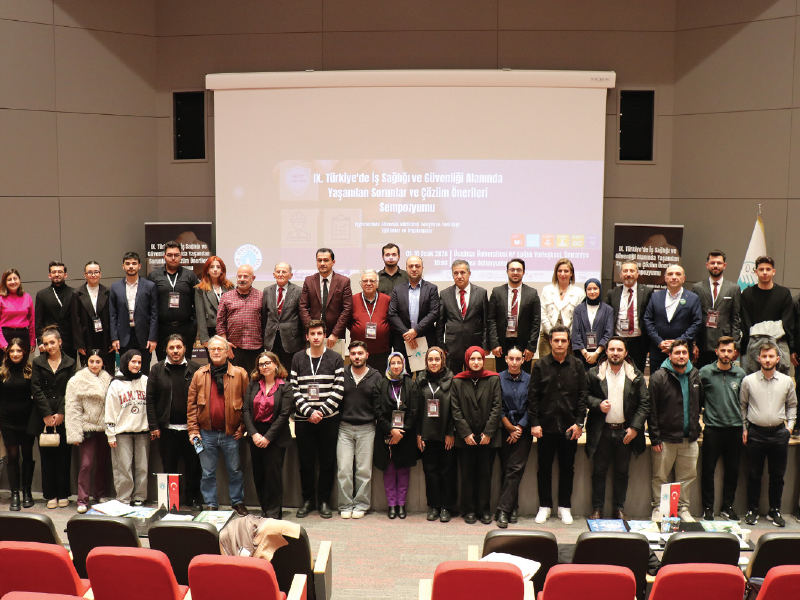
The symposium, held in the İbni Sina Conference Hall of the Üsküdar University NP Health Campus, brought together academics, representatives from the public and private sectors, occupational safety experts, and industry professionals. The event addressed numerous topics including the prevention of workplace accidents, strengthening corporate safety culture, psychosocial risks, digitalization, and occupational health and safety practices in the mining and construction sectors.
The opening speeches of the symposium were given by Dr. Sertaç Temur, Assistant Head of the Occupational Health and Safety (OHS) Department and Symposium Coordinator at Üsküdar University; Dr. Rüştü Uçan, Head of the OHS Department, Director of ÜSGÜMER, and President of the MESKA Foundation; and Prof. Dr. Arif Aktuğ Ertekin, Dean of the Faculty of Health Sciences.

The Symposium Has Become a Lasting Academic Outcome
Dr. Uçan, Assistant Professor, noted that the symposium has become a lasting academic output, stating, “The first event was also published as a book, and this e-book has been downloaded over 170,000 times. This number has made it the second most-followed book of Yıldız Technical University. The Physics Laboratory book was in first place.”
Dr. Uçan emphasized that they regularly meet with industry representatives every year, saying that this approach creates a mutual evaluation process.
Dr. Uçan continued, “In these events, we tried to follow what companies think in this field and what kind of developments they have made. We invite approximately 8-10 companies every year, giving them different topics to see what they are doing. This process allows both them and us to evaluate ourselves, asking questions like, ‘Were we successful this year, what are our shortcomings?’”
We will be organizing a workshop on robotics for the first time in Turkey.
Referring to an important institutional development this year, Dr. Uçan announced that they have joined the Mirror Committee of the Turkish Standards Institute and stated, “This committee is related to the field of robotics. We will be organizing a workshop for the first time in Turkey on April 15-17. We will try to ensure the development of a standard in Turkey together with experts from around the world. It is extremely important to be involved in the process while standards are still in the preparation phase and to develop them in a way that suits our own needs.”
Stating that they are also active in the media to ensure that occupational health and safety issues are addressed correctly in the public sphere, Dr. Uçan said, “In the explosion that occurred in a 14-story building in Beylikdüzü, people were writing in WhatsApp groups that ‘there is a gas smell,’ and after a while, they said ‘the smell intensified.’ However, intervention only took place nine hours after the explosion, and unfortunately, one person lost their life. We need technical measures rather than WhatsApp warnings.”
Dr. Uçan, emphasizing the importance of making natural gas detectors and automatic gas shut-off systems mandatory, stated that earthquake early warning systems are also vital.
Earthquake early warning systems are extremely critical.
“Early warning systems related to earthquake fault lines are also one of the topics today. It is possible to provide an early warning 15-30 seconds in advance. This has not yet been implemented in residential buildings in Turkey, and it needs to be implemented urgently,” said Dr. Uçan. “I have just started my second doctorate. We are working on how early warning systems can be implemented in one of Turkey's largest foundries. If measures such as preventing the overturning of ladles, cutting off the electricity, or activating the generator can be taken within 30-60 seconds during an earthquake, large fires and loss of life can be prevented,” he added.
Dr. Uçan also touched upon Üsküdar University's mission of producing and disseminating knowledge. Faculty member Uçan stated that approximately 10 free e-books have been published to date, and added, “Now we are publishing our book on robots as an e-book. The book has been translated into English, and one of our students is even translating it into Persian. We are doing our best to be helpful.”
Dr. Sertaç Temur: “This year we aimed to organize a symposium on the theme of ‘safety culture’”
Dr. Sertaç Temur, Assistant Head of the Occupational Safety and Health Department at Üsküdar University and Symposium Coordinator, emphasized that values are at the heart of safety culture, and that this approach determined the main theme of the symposium.
Stating that there is a direct relationship between the basic needs of human life and safety culture, Dr. Temur said, “Values such as the need for shelter and food, which are in the hierarchy of needs for a person to continue their own species, are also an extremely important factor in terms of the sustainability of safety culture.”
Dr. Temur, Assistant Professor, stated that the main theme of the symposium was determined in line with this approach, adding, "For these reasons, we aimed to organize a symposium with the theme of 'security culture' this year."

2017 graduates met at the symposium
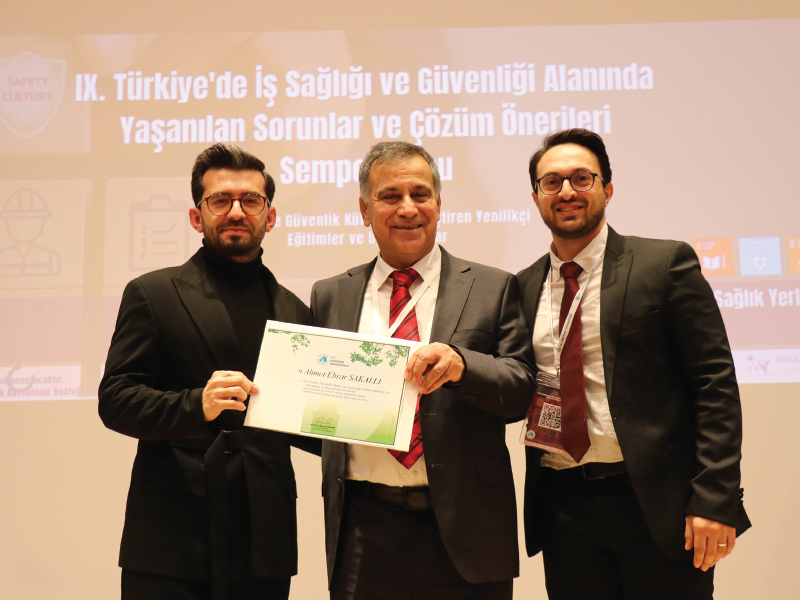
The first graduates of the Occupational Health and Safety Department of Üsküdar University’s Faculty of Health Sciences in 2017 reunited at the ninth Symposium on Problems and Solutions in Occupational Health and Safety in Turkey.
Dr. Ahmet Ebrar Sakallı, who works as a Class A Occupational Safety Specialist at Turkish Airlines, and Dr. Sertaç Temur, Assistant Head of the Occupational Health and Safety Department at Üsküdar University, attracted attention with both their academic and professional careers.
Dr. Ahmet Ebrar Sakallı and Dr. Sertaç Temur are among the first individuals to hold degrees at the undergraduate, graduate, and doctoral levels in the field of occupational health and safety. This achievement once again demonstrates Üsküdar University’s pioneering position in occupational health and safety and its vision for training qualified human resources.
What was done at the symposium?
The first session of the symposium was chaired by Prof. Dr. Haydar Sur. During the session, Selimcan Menemencioğlu, Shell Turkey Occupational Safety and Health Manager, presented on “The First Step; Not Just Starting Work”; Meksut Alev, Soletanche Bachy HSE Coordinator, presented on “Taking Root Cause Analysis a Step Further: Corporate Psychosocial Root Cause Analysis and the Digital Face of Occupational Safety and Health in Construction”; Yılmaz Sonışık from EDİS presented on “Earthquake Early Warning System for the Marmara Region”; and Mehmet Osmanoğlu, Safety, Environment and Health Manager of Gümüştaş Mining, presented on “The Helmet for the Future: Building a Sustainable Culture in Mining”.
The second session, which began after the lunch break, was chaired by Dr. Rüştü Uçan, Assistant Professor at Üsküdar University. Yasin Öztürk, Chief Engineer at Çayeli Copper Mine, presented on “THINK! SAFETY”; Ahmet Ebrar Sakallı, Class A Occupational Safety Specialist at Turkish Airlines, presented on “Employee-Oriented Human Resources Practices”; and Hasan Çelebi presented on “MULTITEK”.
The third and final session of the day was chaired by Assoc. Prof. Dr. Müge Ensari Özay. Ali Rıza Tiryaki from Artı Danışmanlık and Osman Sayar, President of İSGDER, presented on “Problems Faced by Occupational Safety Specialists”, and Ekrem Bayrak from Prosense presented on “Examination of Sensor Selection in Gas Detection Systems from the Perspective of Risk Assessment”. The symposium concluded with a closing speech following the evaluations. During the preparation and execution of the symposium, Research Assistant Ender Sezen, along with undergraduate and associate degree students in Occupational Health and Safety and members of the Scenario-Based OHS Student Club, provided significant support by actively contributing to the organization. The second day of the two-day symposium was held online on Saturday, January 10, 2026.